

Why Diversity in Architecture Visualization Is Not Just Decoration
by Imho in Inspiration on 24th May 2026Diversity in architecture visualization is sometimes treated as a finishing touch. Add a few different people, make the image feel inclusive, and move on. But representation is not only about the surface of an image. It affects how a project is understood, who can recognize themselves in it, and what kinds of use become visible.
A render is a persuasive tool. It can help a client approve a scheme, help a jury understand a proposal, help a community imagine a future space, or help a student explain an idea. The people inside that render are part of the argument.
People are not visual furniture
When people are added only to make a scene feel lively, they become visual furniture. They fill empty corners, hide awkward edges and make the scale look comfortable. That may solve a composition problem, but it misses the deeper question: what kind of public, domestic or civic life is the project proposing?
A diverse set of figures helps designers test more than image balance. It tests access, age, pace, comfort, visibility and use. Can an older person rest here? Can children move safely? Does the threshold feel welcoming? Does the shaded edge invite people to stay, or is it only a nice shadow in the image?
Representation creates trust
People tend to read architectural images through recognition. When a project is shown with bodies, clothing, activities and social patterns that feel connected to the actual users, the image becomes easier to trust. It says: this project is not only located here, it has paid attention to here.
That kind of trust is especially important in projects across African contexts, where visual libraries have often been thin, repetitive or imported from other places. The absence of relevant people is not a neutral technical problem. It shapes what designers can easily imagine and what clients can easily see.
Diversity should be specific, not symbolic
Good representation is not a numbers game inside a render. It is not enough to place one figure from a different background in a corner and call the image inclusive. The more useful question is whether each person belongs to the social logic of the scene.
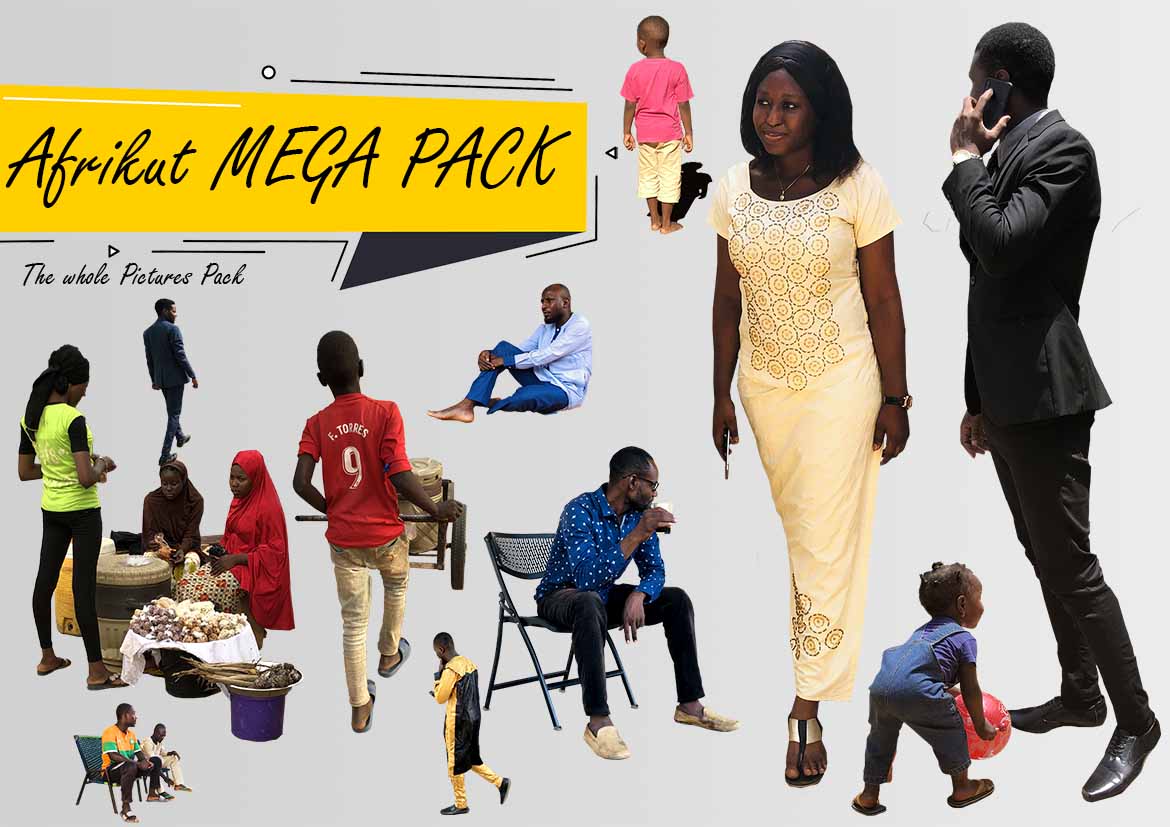
Afrikut’s collections of African men cut-out images, African women cut-out images and African children cut-out images can support that work because they give designers more specific choices. A figure can be selected for posture, age, clothing, direction, activity and mood, not just for visual variety.
The design value of better figures
- They make scale more believable because bodies relate directly to furniture, doors, steps and landscape elements.
- They reveal comfort: shade, ventilation, resting places and informal edges become easier to read.
- They communicate program: a school, market, clinic, park or housing project needs different social scenes.
- They make critique sharper: a render with believable users exposes weak circulation and empty public space faster.
- They help avoid default imagery that makes every project feel as if it belongs to the same city.
A responsibility for image makers
Architectural visualization is not documentary truth, but it is still cultural production. It influences what futures look possible. If the visual language of architecture repeatedly excludes or flattens certain people, it trains designers and audiences to see those people as secondary to the built environment.
Diversity in renders should therefore be handled with care, respect and clarity. Use the right license, credit when appropriate, and choose figures that strengthen the design story. The Afrikut license explains how Afrikut images can be used in educational and commercial contexts.
A good architectural image does not add diversity as decoration. It lets human presence become evidence that the project has understood who it is for.